


2026 Hyundai Santa Fe vs. Toyota Highlander
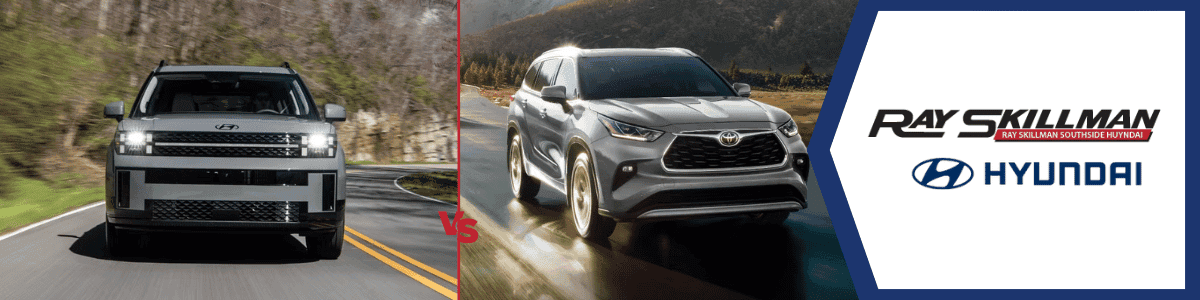
Two Popular Three-Row SUVs Go Head to Head
Picking a family SUV gets tricky when two solid options sit side by side on your shopping list. The 2026 Hyundai Santa Fe and 2026 Toyota Highlander both promise room for the crew, modern tech, and daily-driver dependability. So which one actually fits your life better?
- The Santa Fe brings 277 horsepower and bold styling that looks pricier than its $34,800 starting point.
- Toyota’s Highlander counters with 5,000 pounds of towing capacity and standard all-wheel drive across the lineup for 2026.
- Both SUVs seat up to seven or eight passengers across three rows, though comfort varies in the wayback.
Under the Hood: Power and Fuel Economy
The Santa Fe runs a turbocharged 2.5-liter four-cylinder that cranks out 277 horsepower and 311 lb-ft of torque. For 2026, Hyundai swapped out last year’s dual-clutch transmission for a traditional eight-speed automatic, addressing earlier reliability concerns. A hybrid option pairs a 1.6-liter turbo with an electric motor for 231 combined horsepower and better gas mileage.
Toyota equips the Highlander with a 2.4-liter turbocharged four-cylinder producing 265 horsepower and 310 lb-ft of torque. The numbers run close to the Santa Fe, though the Hyundai holds a 12-horsepower advantage. Highlander buyers can also choose a 2.5-liter hybrid setup rated at 243 horsepower, and that powertrain really shines with an estimated 35 mpg combined.
When comparing the 2026 Hyundai Santa Fe vs. Toyota Highlander on fuel economy, the Santa Fe front-wheel-drive model achieves 20 city and 29 highway mpg. The Highlander sits at 21 city and 28 highway with its now-standard all-wheel drive. The hybrid variants flip the script. Toyota’s hybrid edges out the competition on mpg, making it the pick for high-mileage commuters.
Hauling Gear and Pulling Loads
Families who tow campers, boats, or trailers should pay attention here. The Highlander handles up to 5,000 pounds when properly equipped with the gas engine. That’s a healthy advantage over the Santa Fe’s 3,500-pound maximum. If weekend trips involve anything bigger than a jet ski, the Toyota gives you more breathing room.
Cargo space tells a different story. The Santa Fe measures 79.6 cubic feet with all rear seats folded flat, while the Highlander maxes out at 84.3 cubic feet. With the third row up, the Highlander offers 16 cubic feet behind the back seat compared to the Santa Fe’s 14.6 cubic feet. Neither SUV will leave you stranded at Costco, but the Toyota squeezes in a bit more.
Interior Space and Third-Row Reality
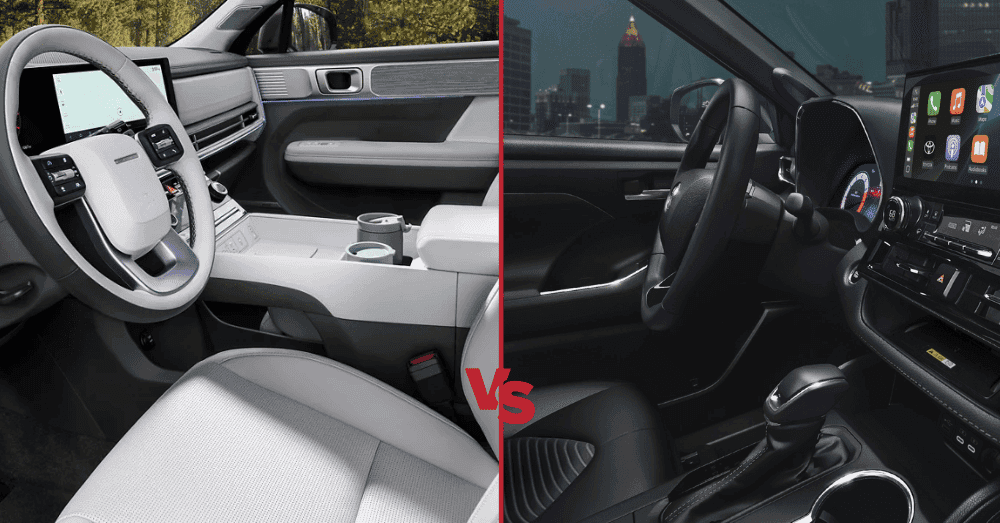
Both SUVs accommodate seven or eight passengers depending on whether you choose captain’s chairs or a bench in the second row. The front two rows feel genuinely roomy in either vehicle, with supportive seats and enough legroom for adults to stretch out on road trips.
Third rows remain the great equalizer in this class. Neither the Santa Fe nor Highlander offers an adults-only back seat. Kids and teenagers fit fine, but grown-ups on long drives will start counting the miles. The Santa Fe’s redesigned platform does create better third-row access, and Hyundai widened the tailgate opening for easier loading.
Tech and Safety on Board
Hyundai’s curved panoramic display steals the show in the Santa Fe. The brand merged a 12.3-inch digital gauge cluster with a 12.3-inch infotainment screen into one sweeping unit. Wireless Apple CarPlay and Android Auto come standard, along with multiple USB-C ports. Physical climate controls stick around too, avoiding the frustration of touchscreen-only HVAC adjustments.
Toyota counters with an 8.0-inch touchscreen on base trims and an available 12.3-inch display on higher models. Wireless smartphone connectivity and a charging pad come on most trims, though the Highlander’s cabin design leans more conservative than the Santa Fe’s modern look.
Safety features run neck and neck. Hyundai SmartSense includes forward collision avoidance, lane keeping assist, and blind-spot monitoring as standard equipment. Toyota Safety Sense 3.0 matches that coverage with adaptive cruise control and automatic emergency braking. The Santa Fe earned an IIHS Top Safety Pick+ rating for added peace of mind.
Picking the Right One for Your Garage
The Santa Fe appeals to buyers who want striking looks, strong standard power, and Hyundai’s generous warranty coverage. It starts at $34,800 for the SE trim, undercutting many competitors while packing in features typically found on pricier vehicles. The bold exterior design genuinely looks like it belongs in a luxury showroom.
The Highlander works best for families who value towing capacity and Toyota’s reputation for long-term reliability. Standard all-wheel drive for 2026 adds confidence in winter weather or on unpaved roads. The hybrid option stands out as one of the thriftiest three-row choices on the market.
Both SUVs handle family duties with confidence. Your final choice comes down to priorities. Want more power and style for less money? The Santa Fe has you covered. Need serious towing muscle and proven resale value? The Highlander makes sense.
Find Your Santa Fe in Greenwood
Ready to see how the 2026 Hyundai Santa Fe fits your family? At Ray Skillman Southside Hyundai, we keep a wide selection of new Santa Fe models ready for test drives. Our team can walk you through every trim level and help you explore hybrid options if fuel economy tops your list. We also offer flexible financing through relationships with over 40 lenders. Stop by our Greenwood location and experience the Santa Fe firsthand.
0 comment(s) so far on 2026 Hyundai Santa Fe vs. Toyota Highlander